
A bought list
Every company matching an industry code and a headcount band. Twelve thousand rows, sorted by nothing in particular.
coin.im
I post paper letters. They go to the people your sequences have been bouncing off for two years, behind an assistant, a filter and a habit. Inside each envelope is something with weight, addressed to a person by name.
You are buying a campaign. You are also watching it being thought through: which market, which people, which sentence.
Sometimes they reply.
The scan is paid work. It starts once the invoice is settled.
Envelopes a courier or a postal service physically carried.
I printed, packed and posted them myself. Most crossed a border.
The market
Most direct mail fails before anyone writes a word of it. It goes to a list somebody bought, filtered by industry code and headcount. An industry code records what a company told a registrar years ago. It says nothing about what is going wrong there this quarter, and what is going wrong is the only reason anybody answers a stranger.
I start one step earlier. Before a list exists I work out which markets have a reason to answer you now, and which ones would read your letter politely and do nothing. This is the part clients understand least, so it has a page of its own.
What you get is the working. The hypotheses I began with, the ones that survived contact with evidence, and the ones I dropped, each with the reason it was dropped. A market I talk you out of is a result. Losing one on paper is cheaper than losing it in the post.
The rules the scan follows were written down across outbound work with more than six hundred and eighty businesses, in the ordinary way: something failed, the reason was identified, and a rule was added so it would not fail the same way again.
Every company matching an industry code and a headcount band. Twelve thousand rows, sorted by nothing in particular.
The four hundred with a reason to answer you this quarter, each one carrying a note that says what the reason is.
The scan reads a business before it reads a market. Send me what you already have: the site, the deck, recordings of calls with your own customers, anything that says what you sell and to whom. That material becomes your business file, and the chronicle is built from it.
You choose how deep the scan goes. A site and a deck gets you a working chronicle. Add ten call recordings and the hypotheses stop being guesses about your buyer and start being quotes from them. That trade is yours to make.
Open a business fileNothing here is automated. You send the material, a person reads it, and the first chronicle comes back within 72 hours. What I do with your file
How a market is read, how the hypotheses are named, what gets pruned and by what standard, and what I measured afterwards to find out whether any of it worked.
Read Market ScanCompanies and addresses
A market is not a mailing list. Stage two turns one into the other, and most of it is done by hand.
For each company I find the person who owns the problem rather than the person whose title sounds nearest to it. Then I find where that person's post physically lands. A registered office is not an answer. About one company in four is registered at an accountancy firm two streets away who will bin your envelope without opening it, and they will do it efficiently.
Every address is confirmed against at least two independent sources. Where the sources disagree I either resolve it or delete the record. Between a tenth and a quarter of a scanned market does not survive this stage, and the list you receive is shorter than the list I started with. A letter that arrives at the wrong desk costs more than a short list does, because printing was never the expensive part.
A precision engineering firm in Sheffield, forty staff. It is on the list because it posted three machine operator vacancies in six weeks.
The letter goes to the operations director, who signs off the machines. Their Head of Manufacturing has the closer job title and does not hold the decision.
Unit four, on an industrial estate east of the city. The building has six units and the number matters.
Confirmed on the fourteenth of August, against the company register and their own careers page.
Tracked post, signature available on that route.
I could not confirm whether the budget sits with the operations director or the managing director. That line is marked unconfirmed.
The letter
Something solid in the envelope keeps it out of the stack with the invoices. It gets opened, because nobody can tell what is inside without opening it, and because a shape in an envelope is a small unanswered question.
That is the entire trick of the object, and it lasts about ten seconds. After that the letter is on its own.
So the letter opens by naming something true and specific about the recipient's operation: a sentence that could not have been posted to anyone else. If the first sentence would survive a find-and-replace of the company name, it is the wrong first sentence and it gets rewritten.
One page. One ask. The ask is small enough to answer on the day it arrives: a reply, a short call, a sample sent back. I do not ask a stranger for an hour of their week.
The object is chosen for the argument, not for the budget. The expensive one is often the wrong one. I have talked clients out of the object they liked most, because it made the letter about me, and a letter about me is a letter about nothing.
Production and delivery
Production is the easiest stage to ruin. Paper that goes by post behaves differently in a sorting machine than it does on a desk. An enclosure that rattles reads as a sample nobody ordered. A customs declaration filled in casually adds four to nine days at a border, and sometimes a charge of $15 or $20 the recipient is asked to pay, which is a poor way to introduce yourself.
The envelope, the mailer, the protection and the postage are designed around the finished piece, in that order. A letter that arrives crushed has lost before anybody touches it, and the cheapest way to crush one is to choose the packaging last.
I print, pack and dispatch from one manifest, and you hold the same file I work from, line for line.
Four hundred letters printed on 120gsm cream, from the proof you approved on the second of September.
Four hundred brass keys, one to an envelope, each one packed and weighed at thirty-eight grams.
Four hundred envelopes addressed by hand, sixty of them carrying customs forms for the addresses across a border.
All four hundred out of the building on the ninth of September, three hundred and forty on one route and sixty on another.
A tracking number against every record the route gives one for, and a note on the ones it does not.
Every letter travels one of two ways, and the list says which. Most go by post: a real stamp, a tracked route, and a delivery scan or a signature at the other end. Where the address is a single person on a single floor and the argument is worth it, a courier carries the envelope into the building and puts it into that person's hands, and comes back with a name and a time. The courier costs roughly three times the postage, so it is chosen record by record, and it is the reason the price below is a range and not a number.
Either way, delivery comes back as evidence rather than as a summary. Every record ends in one of four states, and the states are counted as they are. It is not done when it leaves me. It is done when delivery is recorded.
Every record keeps the reason it was chosen. When a reply arrives it is still attached to the person, the address, the object and the hypothesis from stage one that put that company on the list. That is what makes a second campaign roughly a third cheaper than the first: you are not starting from a blank market, you are starting from the part of it that answered.
Four stages, and none of them can be skipped by paying more for the last one.

Object one of twelve
Nobody can tell what is inside this envelope without opening it. Something inside it has to be picked up.
The letter around it names the company in its first sentence, and asks for one thing small enough to answer the same day.
Seven of the twelve letters stop in the middle of a sentence. That is deliberate.
Every campaign carries one object. It is why the envelope gets opened, and why the letter is still on the desk on Thursday. Nobody mistakes it for a gift, and it is not there to be liked. It is there to make the argument physical before the first paragraph has to make it in words.
Twelve are shown here, each with the opening of the letter it was built for. They are examples rather than a catalogue: the right object is the one that carries your argument, and if none of these does, I make something else. Every letter below is real work, written to be sent.
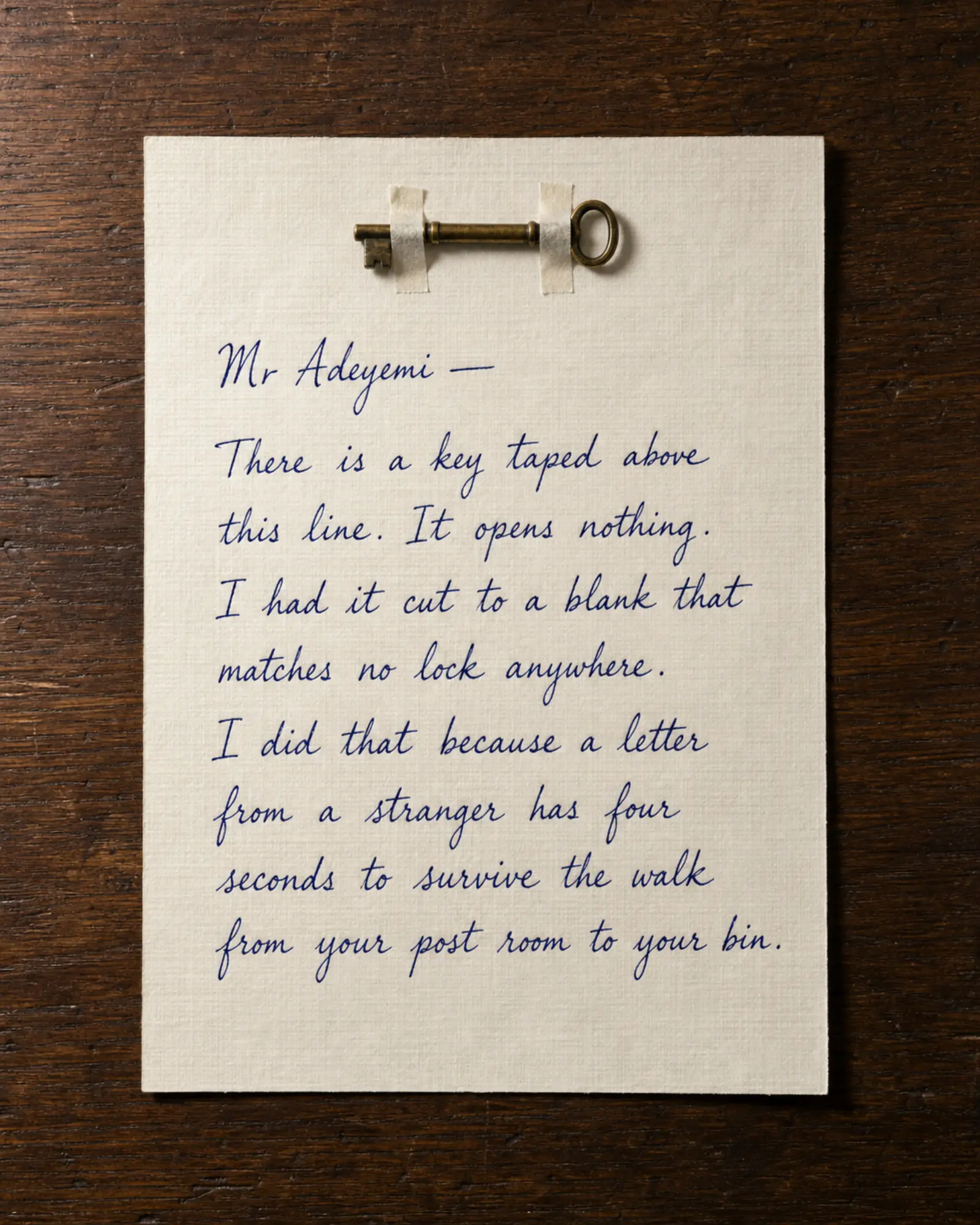
For access, a closed opportunity, real estate, or negotiations.
A key opens nothing by itself.
It puts a door in the letter: there is a way in, and not everyone has been handed one.
In a letter, a key reads as an invitation through one specific door.
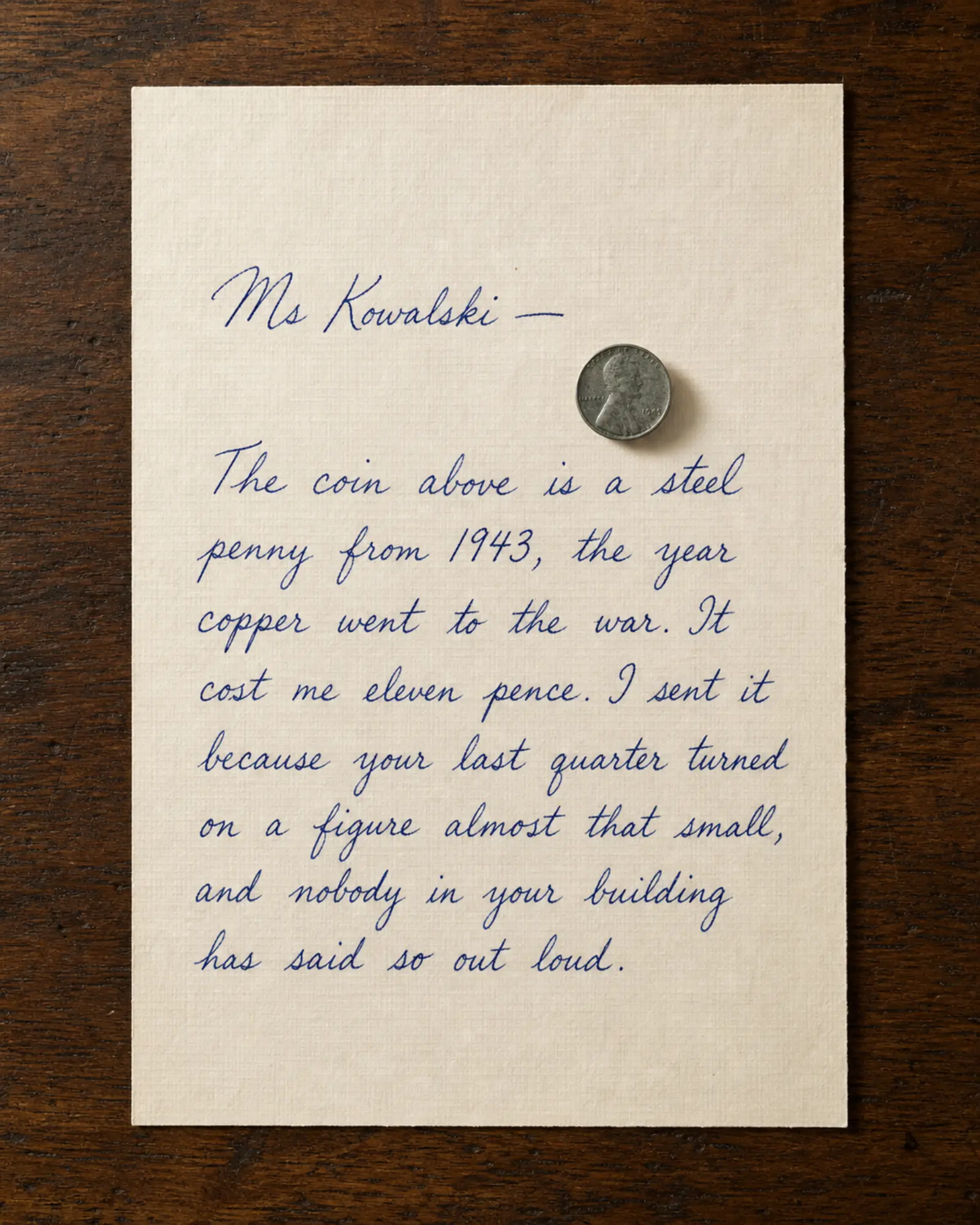
For letters about money, profit, savings, and cost of error.
Money in the hand works harder than the word “money” on a page.
A coin-shaped token sets the subject: this is about real money, not an abstraction.
An old-looking token or unusual coin-shaped piece works especially well when the subject is inflation, devaluation, financial memory, rarity, a nonstandard solution, or the cost of delay.
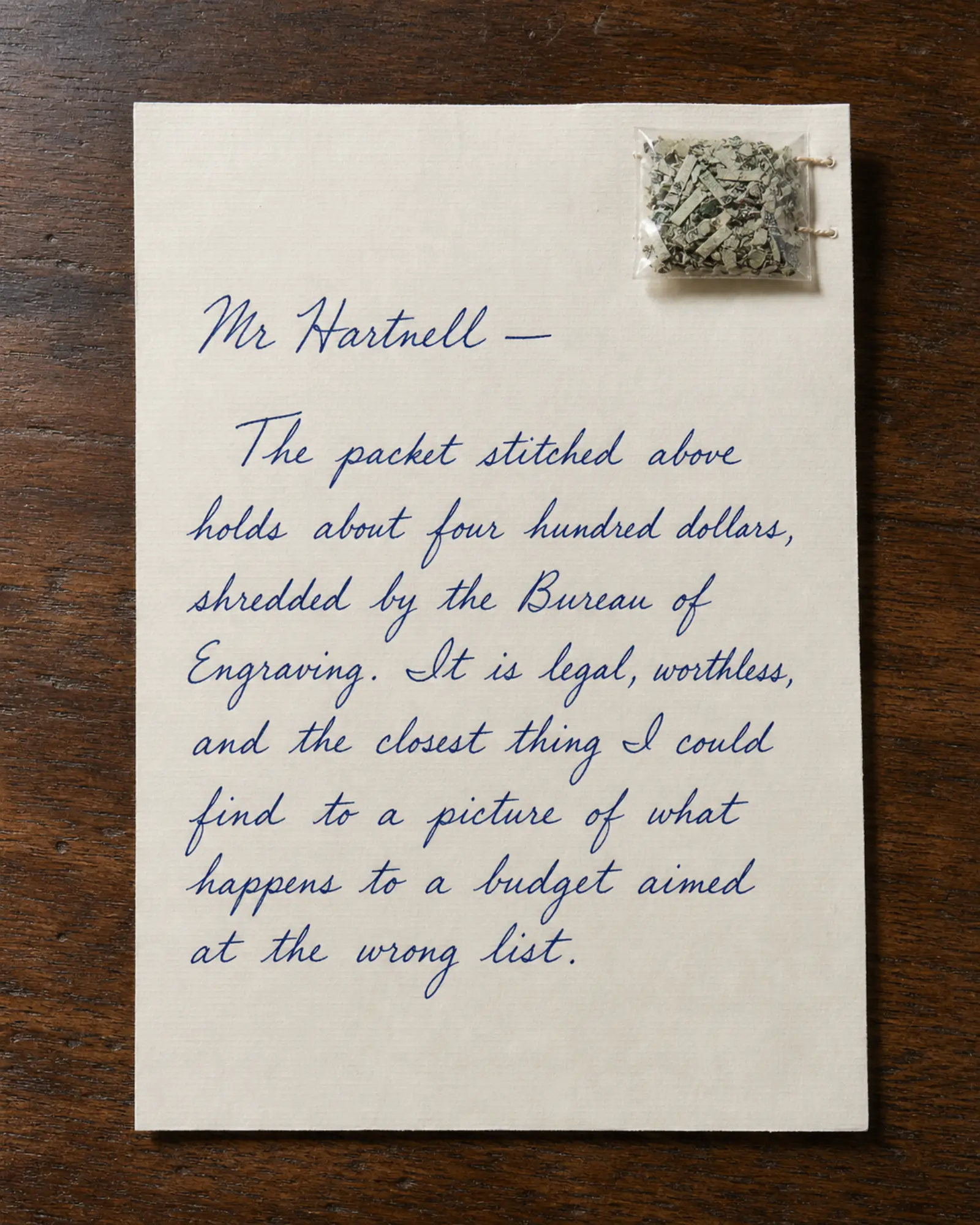
For a budget spent in the wrong direction: expensive leads, an advertising line nobody can defend, a channel that stopped working two quarters ago.
Shredded currency is sold legally by the mint that destroyed it. It is money that is no longer money, which is exactly the argument. A coin says this letter is about value. A packet of shredded notes says something sharper and less comfortable, and it should only be used where the recipient can be expected to agree.
It works best when the reader already suspects the waste and has not yet said so to anyone.
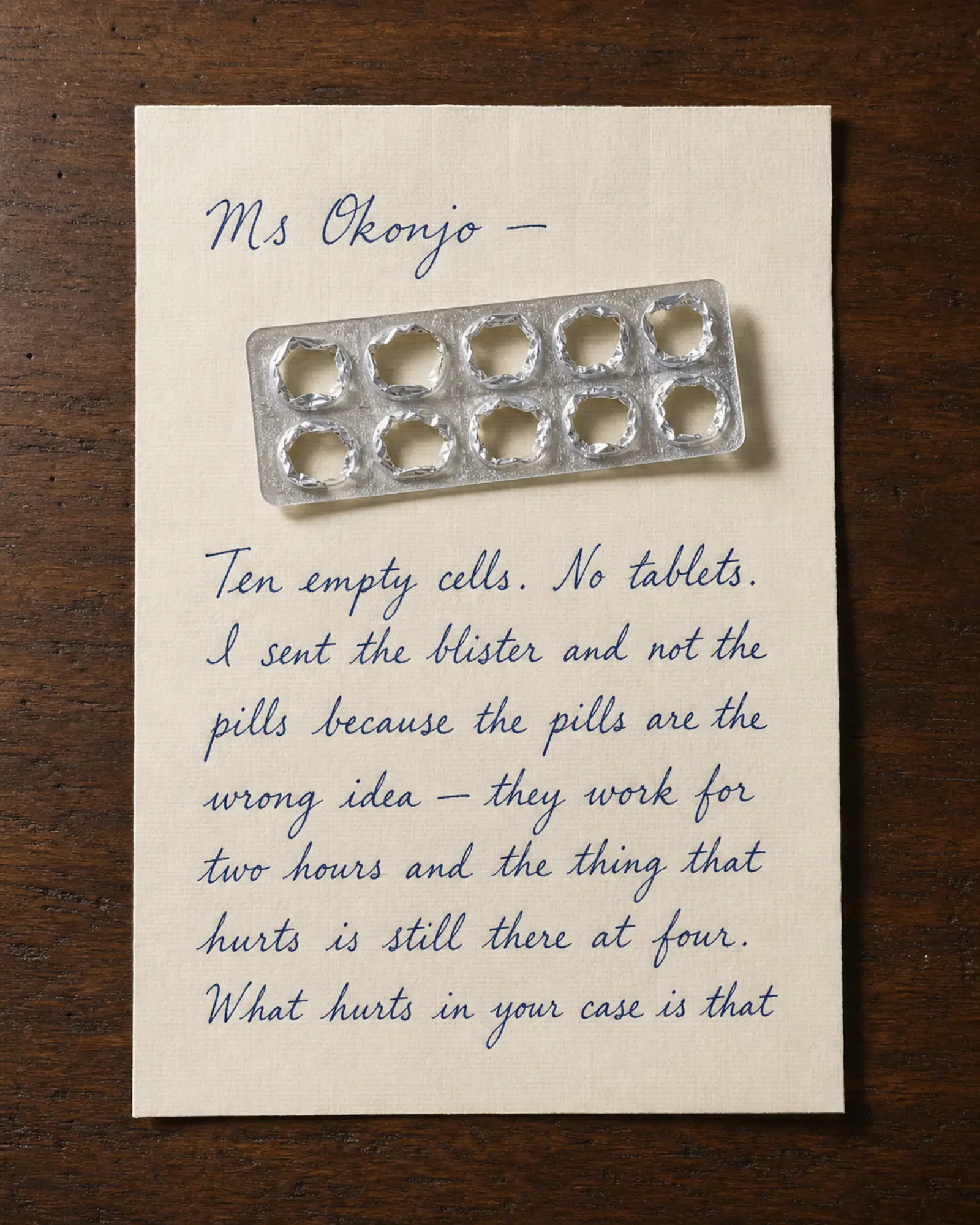
For letters that begin with a specific pain: expensive leads, an empty sales pipeline, debt, or overload.
The blister-shaped card names the pain before it offers anything.
Before the first paragraph, the recipient understands: this is about my headache.
A stress card makes the same move differently. It turns pressure into a small physical test.
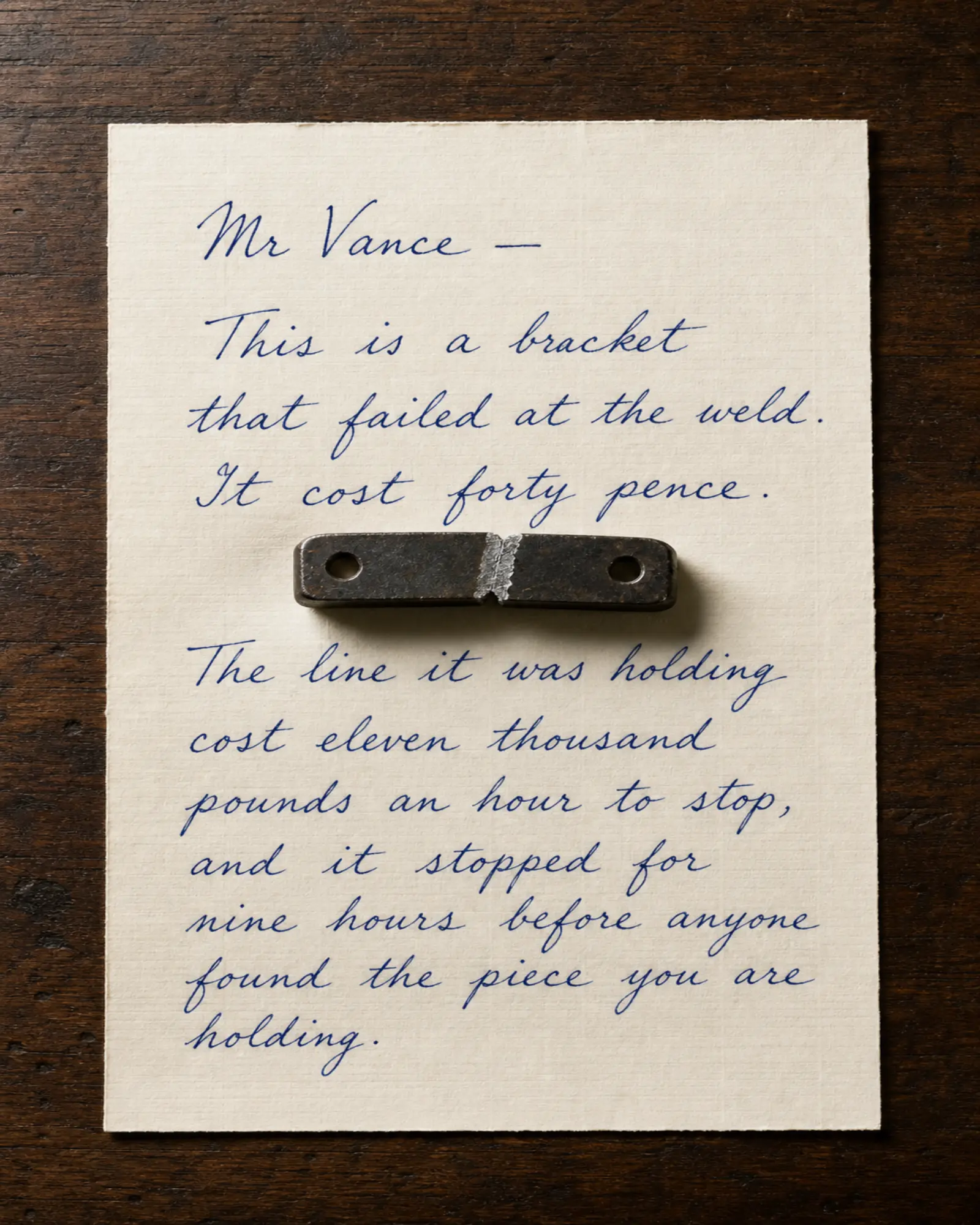
For letters about repair, replacement, insurance, and quality.
A broken thing can make risk more believable than a polished image.
The opening can be brutally simple: “I included this broken part for a reason. Big expenses start with small things like this.”
First a crack. Then a stoppage. Then urgent repair. Then people explain why no one noticed the problem earlier.
In letters about quality, safety, and losses, a broken part does the main thing.
The error is no longer in the report. The error lies on the table.
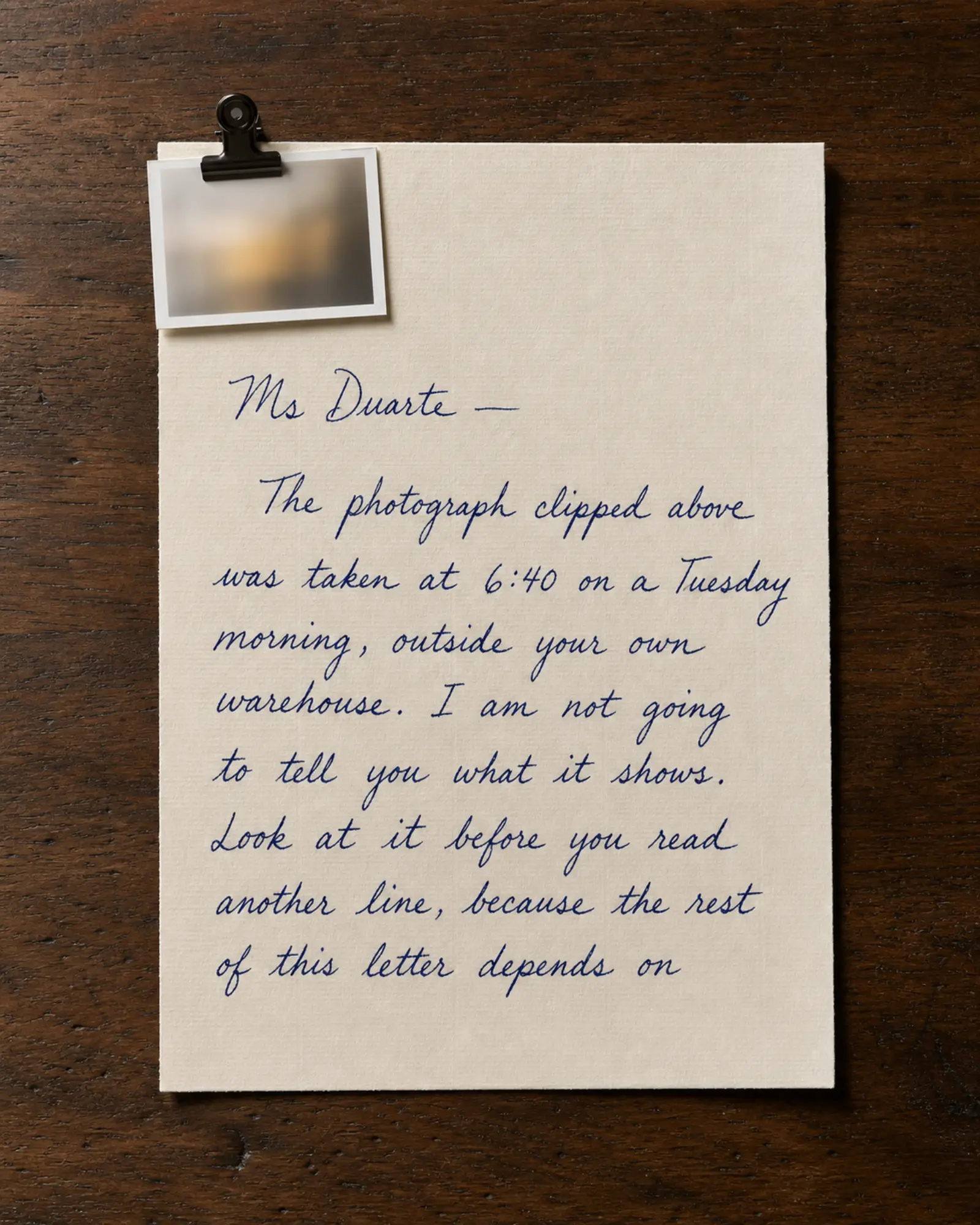
For proof: a property, warehouse, production line, or product.
A photograph is for the claim a reader would otherwise wave away.
It says: this exists. This happened.
For a complex product, a general view is usually weaker than one precise detail: a seam, connection, edge, material, package, finish, defect, or result.
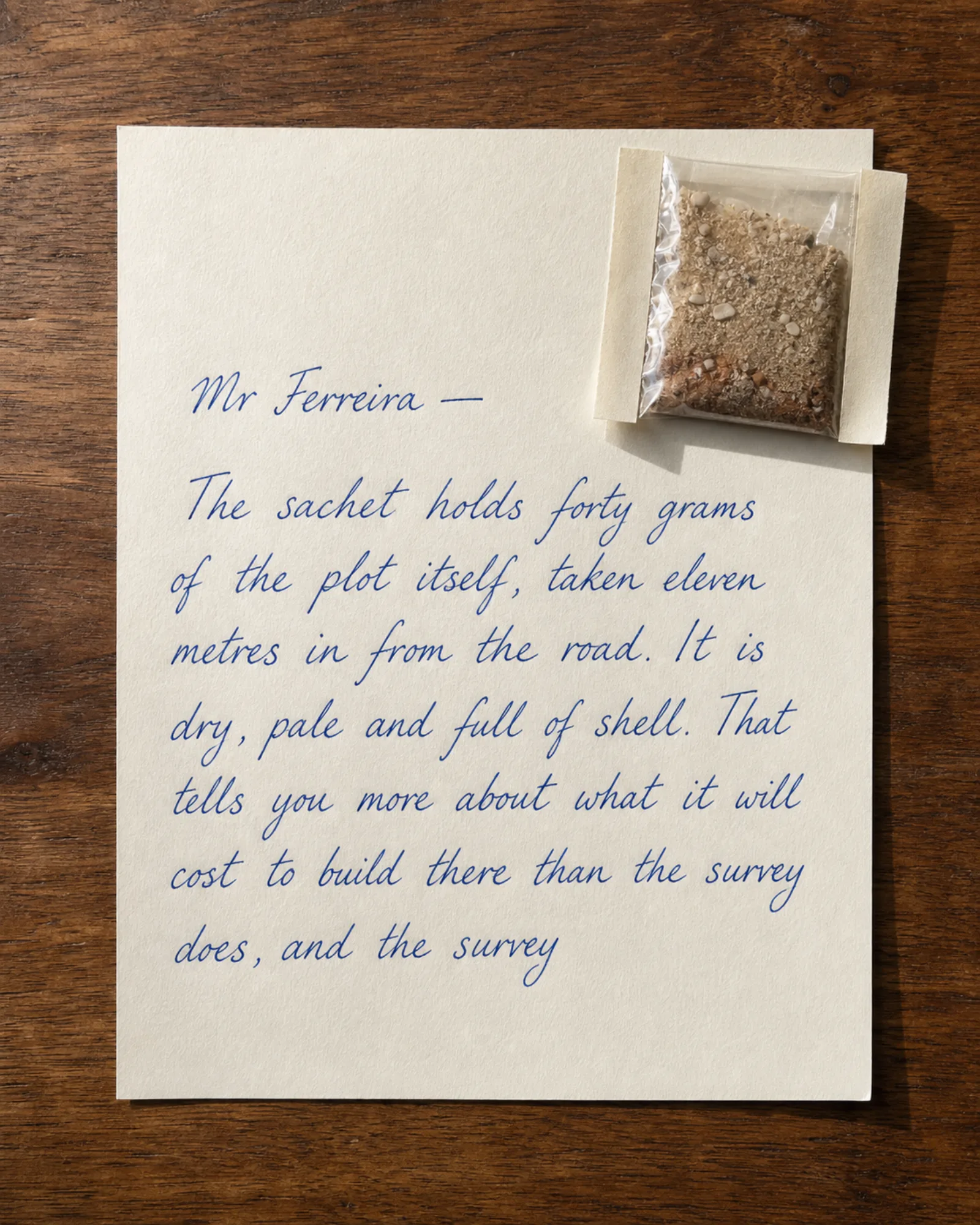
For land, beach, resort, and construction.
The letter puts a small part of the location into the recipient’s hands.
The plot stops being a line in a PDF. The beach stops being a picture. The construction site stops being a promise.
Road access, neighbours, footfall, route, future development, and land value stop being abstractions. They become physical context.
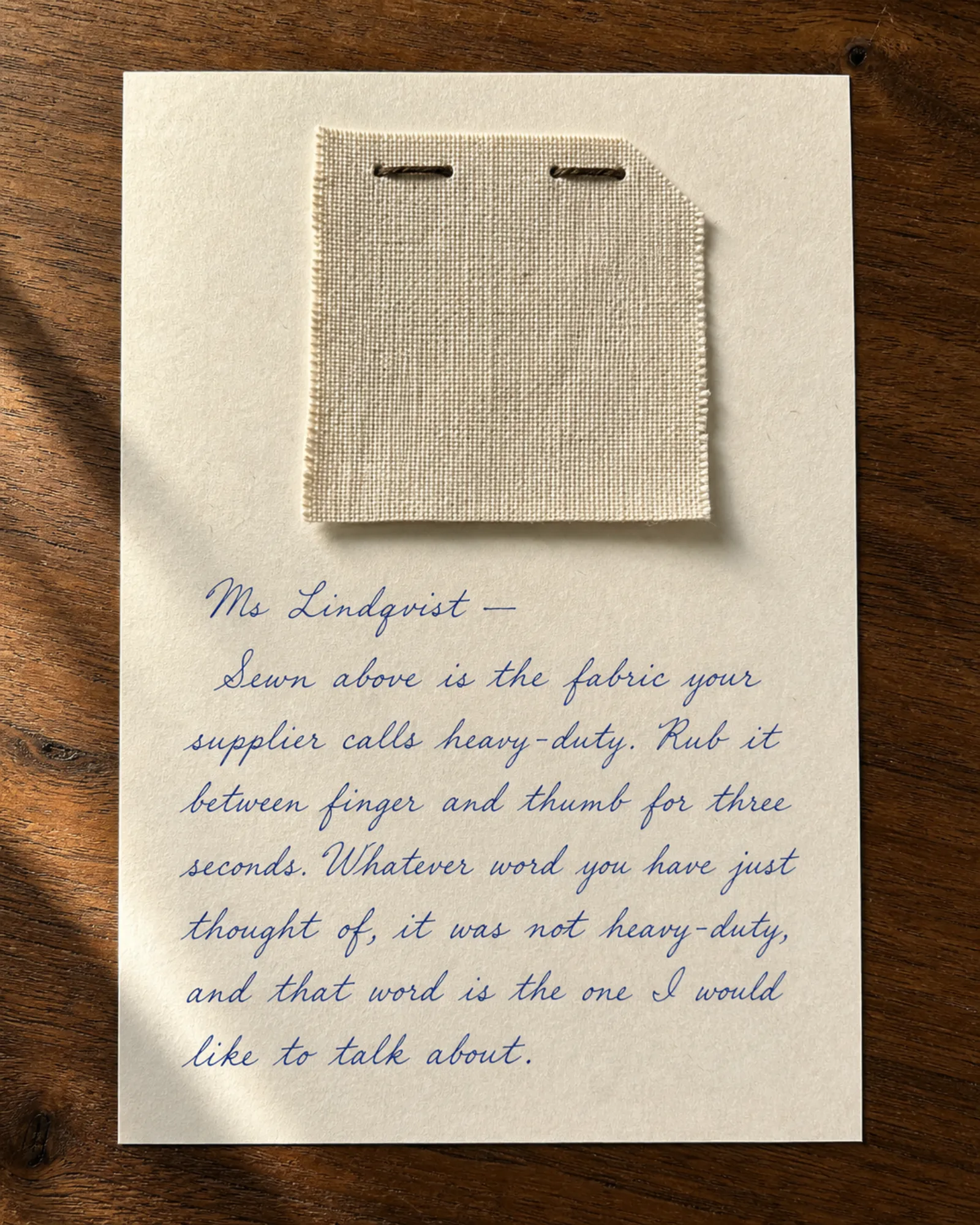
For manufacturing, construction, finishing, and packaging.
Material is better touched than described.
You can write “dense,” “expensive,” “reliable,” “pleasant to the touch” as much as you want. One real sample settles the question faster.
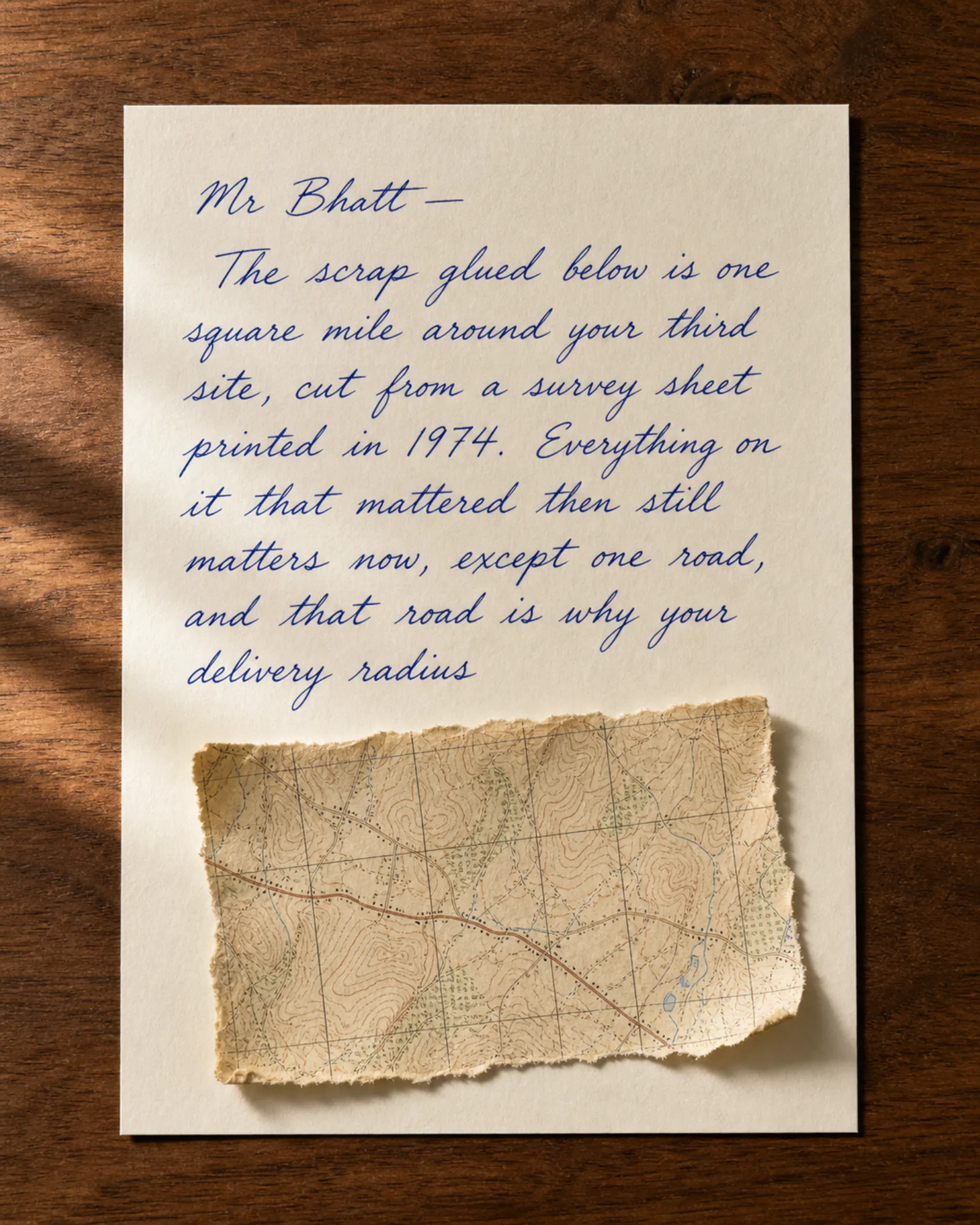
For place, movement, route, or delivery radius.
A map is the one object here the recipient checks against what they already know. They look for their own building on it first, and everything the letter says afterwards is read against whether that mark sat in the right place.
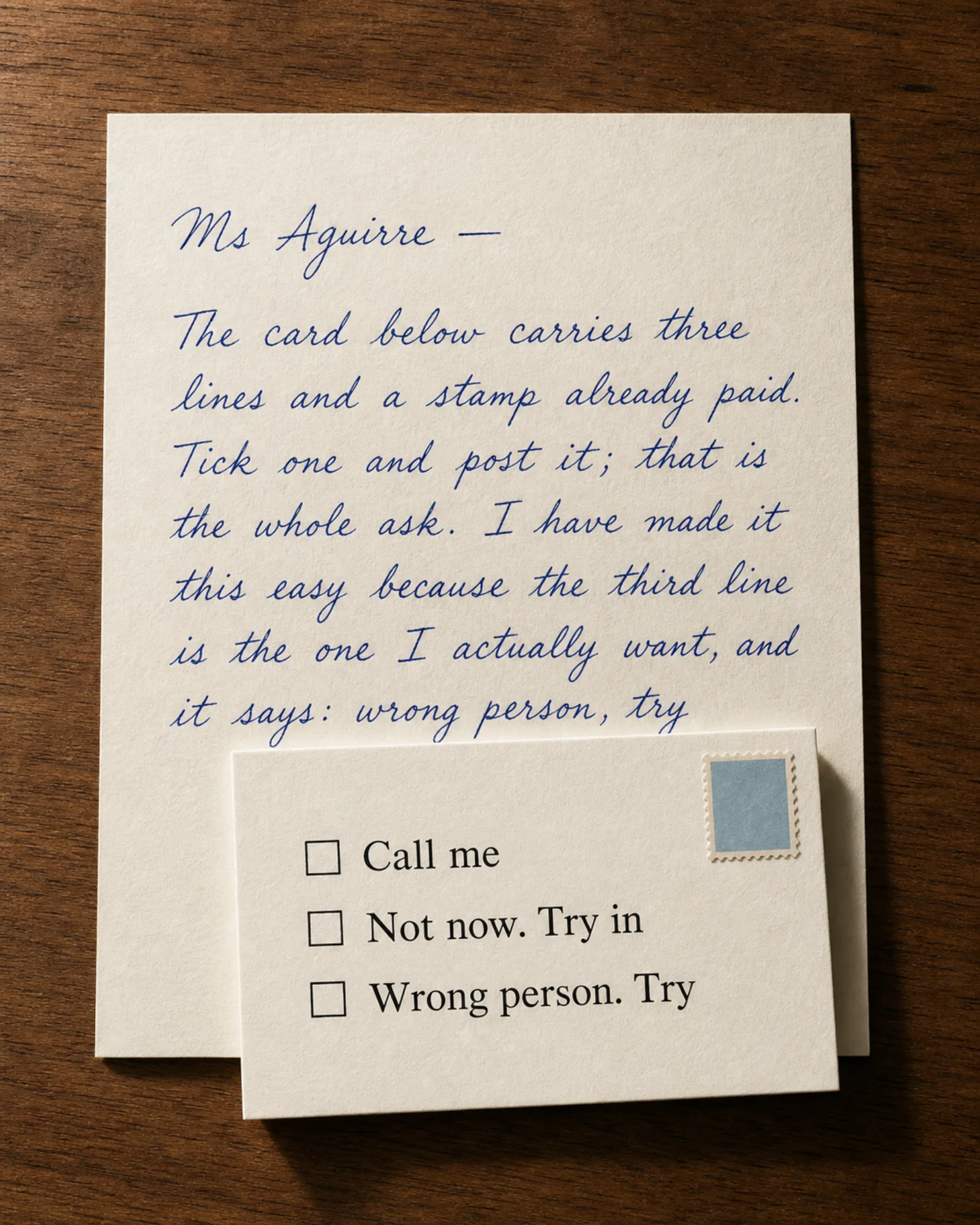
For letters where an answer is needed: qualification, survey, signal of interest, or application.
A prepaid reply removes one excuse. The recipient does not have to work out how to answer.
A questionnaire or check-style form works even harder: there is an action to complete. It no longer feels like ordinary paper.
When a person sends back a form, questionnaire, or short answer, you get a clean signal: they noticed, understood, and acted.
And they will almost certainly remember who asked the question.
My card carries three lines and a box beside each. Call me. Not now, try in [month]. Wrong person, try [name].
The third line is the one that pays. A person who does not want the offer usually knows who does, and writing one name is easier than explaining a refusal. A campaign that collects those names ends better routed than it started.
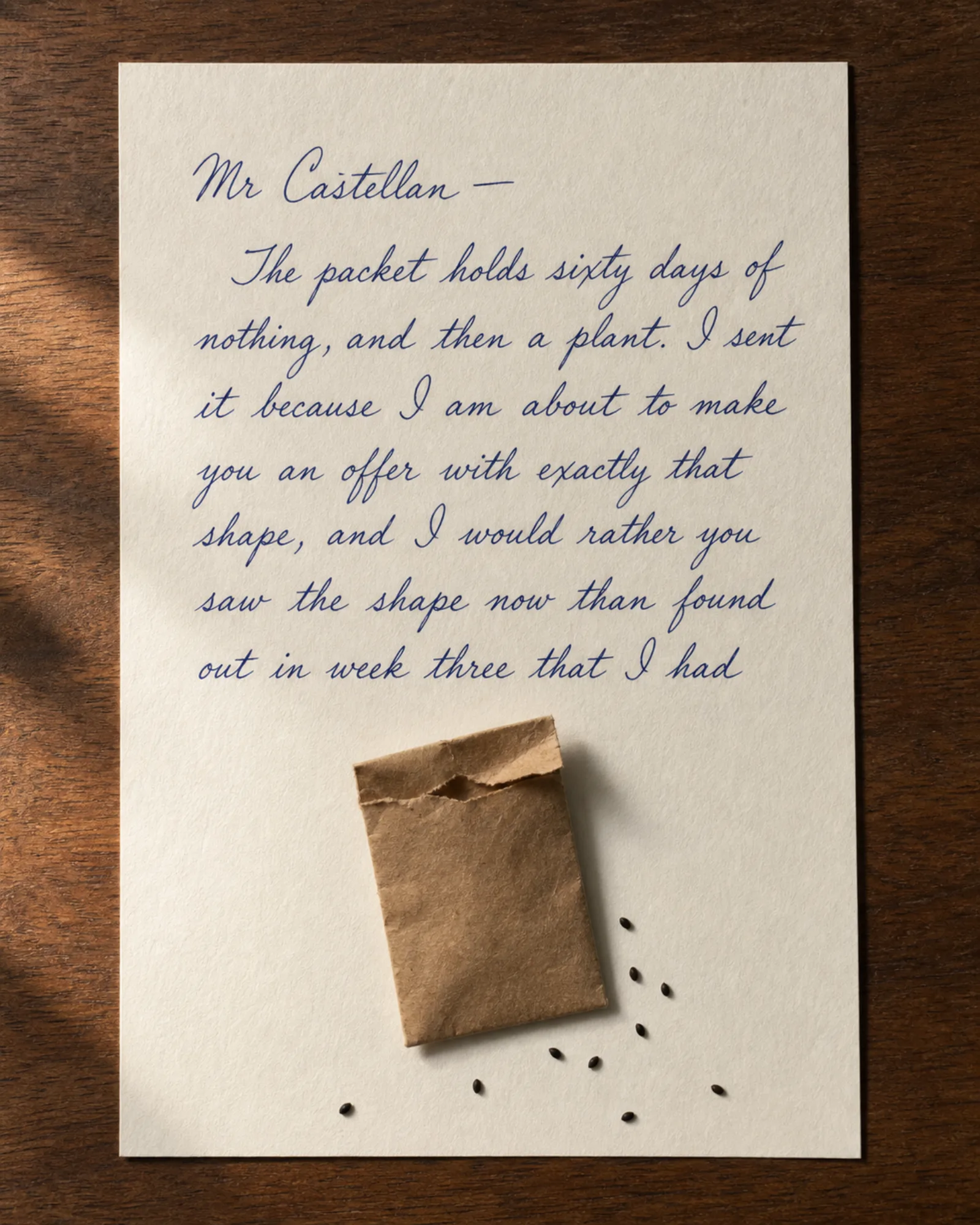
For a long sales cycle, and for any offer where an honest answer is measured in months rather than weeks.
Seeds do nothing for sixty days and then do everything at once. That is the shape of most serious commercial work, and it is the shape most sales letters pretend not to have. Sending seeds says the timeline out loud before the recipient has to ask about it.
It disqualifies you with anyone who wants a result this month, which is the point. Those campaigns end badly for both sides.
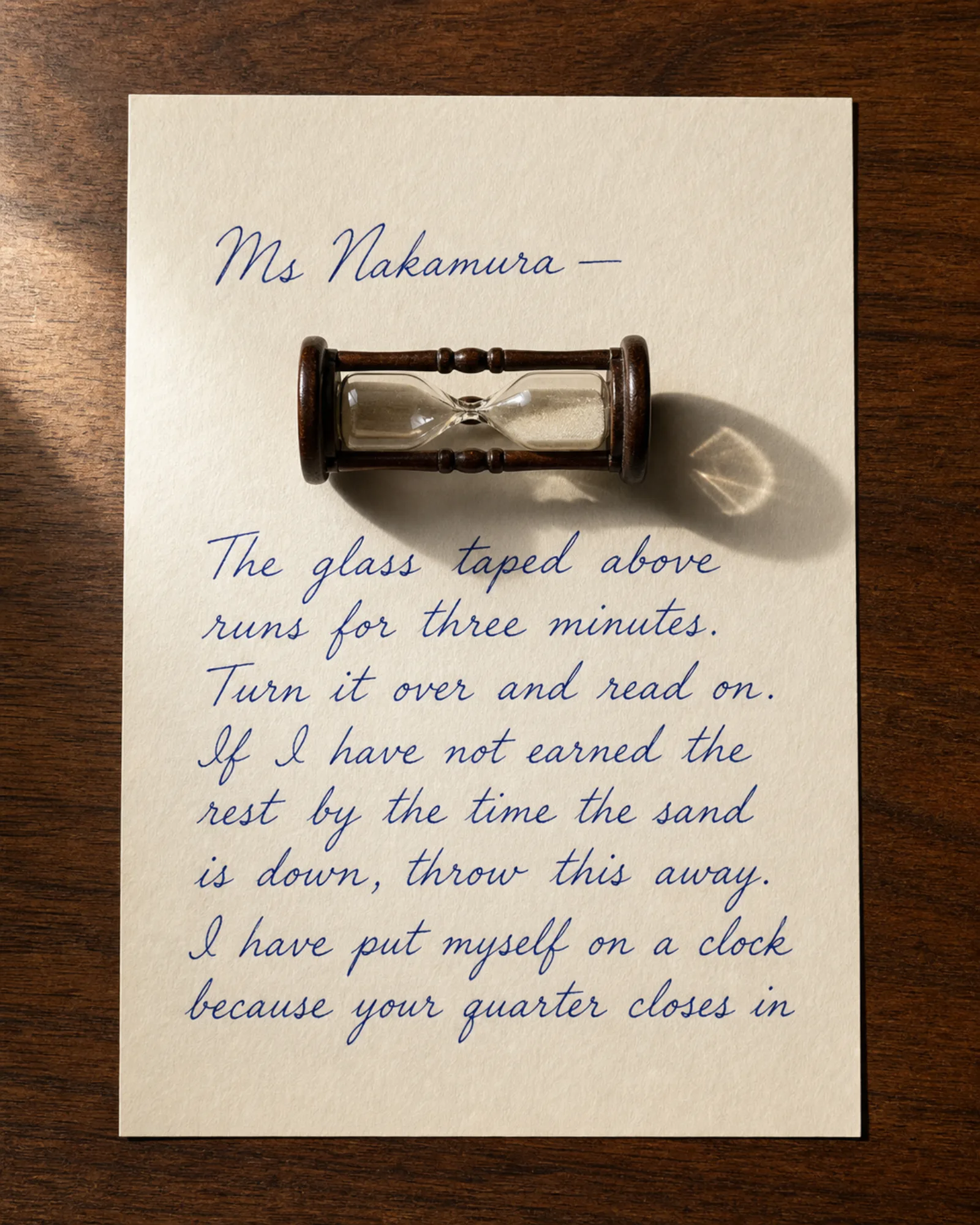
For a deadline that exists whether or not anybody replies: a quarter closing, a budget cycle, a rule taking effect, an offer with a date on it.
A timer in an envelope is a strong move and an easy one to ruin. False urgency is obvious and it costs the sender everything. Used against a real date it does something no paragraph achieves: it puts the writer on the clock as well, because the letter now has to earn its reading before the sand runs down.
If there is no genuine deadline, this is the wrong object and I will say so.
Other objects exist and do not appear here: a feather against a quill, a piece of coal for value that still looks unattractive, a ticket or a blank card where the invitation matters more than the thing. The list grows as campaigns need it to.
An envelope is judged in about two seconds. In the hand, before the eye has done anything useful. By the time the reader has focused on the first line, they have already decided whether this is a document or a piece of post to be dealt with later, which usually means never. Almost everything below is spent on those two seconds. The letter itself only has to survive them.
Weight is the first signal and it arrives before sight. Ordinary office stock is 80gsm and feels like a form. At 120gsm and above the same envelope reads as deliberate. Somebody chose this, and choosing costs money. Nobody consciously notices the difference. Everybody acts on it. It is the cheapest change on this page and one of the two or three that matter most.
Then the fingertips. Cotton stock, laid paper with its ribbed grain, sheets with visible linen inclusion: all of these register as personal. A smooth coated surface registers as advertising, because advertising is what it is usually used for. The test is blind: hand somebody two envelopes without letting them look, and they will tell you which one is important.
The envelope carries no transparent panel. An envelope with a panel is a bill, and it goes wherever bills go, which is not where letters go. That sorting happens before anyone has decided anything, and no amount of good writing inside recovers from it.
Cream, grey-blue, deep green, and never the standard size. A square or an elongated format refuses to stack, so it sticks out of whatever it is put on top of. It also fails automated sorting, so a posted piece is handled by people the whole way. Slower, more expensive, and better. A couriered piece is handled by one person the whole way, which is the same argument taken to its end.
On anything that goes by post, a real stamp, stuck on by hand, ideally an unusual one. Metered franking says a system sent this. A stamp says somebody stood at a counter. The difference is visible before the envelope is opened and costs almost nothing to make. A couriered envelope carries no stamp at all, and no stamp is its own signal: somebody paid a person to walk this in.
On short runs the address is written by hand. This is the strongest signal available on the outside of an envelope and the one that scales worst: four hundred addresses can be written, forty thousand cannot. Where a campaign is small enough, I write them. Where it is not, I say so rather than printing a font that imitates handwriting, which fools nobody and insults the reader who notices.
Where the piece warrants it, the envelope closes with wax. A seal is the only closure that cannot be opened and shut again without saying so, which tells the recipient two things before they read a word: the letter arrived as it left me, and nobody read it first. It also has to be broken with a thumb, which is a physical act performed before any reading has happened.
The letter is printed letterpress where the run allows it. Letterpress presses each character into the paper, leaving an impression you can read with a fingertip and see against the light. Digital printing cannot reproduce it. Neither can a competitor working at volume, because the method stops making economic sense somewhere above three thousand pieces. That is the same threshold where this whole channel stops making sense.
Blind debossing goes further: a mark pressed into the sheet with no ink at all. It is read by touch before it is seen. One word, or one device, and nothing more. A page of it becomes decoration, and decoration is what I am trying to avoid.
There is one physical action between the envelope and the letter. A sheet folded in three and tied with thread. A tissue leaf laid over the page. A folder that has to be opened rather than a page that falls out. Each movement of the hand is another second in which the reader is already involved, and involvement before reading is worth more than any opening sentence.
Smell works on memory longer than anything else in this list, and it is also the easiest thing here to get badly wrong. Perfume in a business envelope reads as manipulation and is resented. What works is the smell a material already has: cedar shavings, leather, sealing wax, ink still fresh on a letterpress sheet, cotton paper on its own. The scent should be a consequence of what the piece is made from, never an addition to it.
Something in the envelope is left unfinished. A line with a figure for the reader to fill in. A tab to be torn. A card to be sent back. An unfinished action stays in the mind longer than a completed one, and a reader who has picked up a pen is no longer reading an advertisement.
Paper goes in the bin within the week. A key, a coin, a broken bracket does not. It moves to the edge of the desk, then to a drawer, and every glance at it is another contact I did not pay for. This is the real argument for putting an object in the envelope, and it has nothing to do with the object being clever.
What lasts longer than the object is the thing the reader did: broke a seal, untied a thread, wrote a figure, posted a card back. An action performed is remembered far better than a page read.
And what lasts longest is the story. A letter that arrives in a way somebody describes to a colleague over lunch has done something no amount of paper stock achieves on its own. That is the only part of this I cannot manufacture, and it is the part I am actually aiming at.
One desk, one working day: 117 emails and 153 Teams messages, and most of the emails are skimmed in under a minute. Microsoft measured that across its own Microsoft 365 telemetry and a survey of 31,000 workers in 31 markets, and published it in June 2025.
Post went the other way. American mail volume peaked at 213 billion pieces in 2006. In the year to September 2025 it was 109 billion, a fall of almost half, and it is still falling.
Producing a cold email became free, and landing one became a trade: warmed domains, rotated addresses, sentences written to slip past a filter rather than to convince a person. That trade is real, and everybody selling to your buyer has already bought it. It is the price of entry now, and entry is where it stops.
A physical letter cannot behave this way, and that is the whole argument. Nobody receives two hundred envelopes in a day, because nobody can afford to send them. Paper costs money. The object inside costs money. Packing, postage and a delivery record cost money. Every one of those costs is a barrier, and the barrier is what keeps the channel worth using. Email lost its barrier and lost its value at the same time.
The expense also changes what happens before the send. An email campaign has no reason to verify an address, because a wrong one costs nothing and a bounce is not an event. I check because an unverified record costs me paper, an object, postage and a delivery attempt. I would rather burn a great deal of machine time confirming a record than post one envelope to a company that dissolved last year. That is not diligence for its own sake. It is arithmetic.
I collect email addresses in the course of the work. I do not sell them and I do not hand them over, not as a bonus and not on request. What I sell is a street address that a physical letter can reach. If you want an email list there are companies that will sell you one, and the fact that they will is most of the problem.
I would rather post four hundred letters that land than four thousand that arrive.
01
You tell me what you sell and who you think ought to answer. I come back with the markets worth writing to, the ones I would skip, and the reason for each. About one brief in five ends at this step. That is a cheap place for a brief to end.
02
You approve the list, the letter and the object, and you approve them separately. Approving the letter means reading it word by word: the first sentence decides more than the paper does.
03
I print, pack and post. You get delivery evidence for every record, and the replies as they come back, still attached to the reason that record was chosen.
I do not start a print run to protect a date in a calendar. If approval slips, dispatch slips with it.
A Market Scan is $2,400. A campaign runs between $28 and $110 per recipient, all in: the list, the letter, the object, production, delivery and delivery evidence. Post with a light object sits at the bottom of that range. A courier walking a heavier object into a building across a border sits at the top. The object and the route decide where you land, and I tell you the number per record before anything is printed. My smallest campaign is 150 recipients. I quote before any work starts, and the quote does not change afterwards unless you change the brief.
The first chronicle comes back within 72 hours of your material reaching me. Building the list runs about ten working days for 400 records, because most of it is done by hand. The letter reaches you five working days after you approve the list. Production and packing take another five. Then delivery: three to ten days by post inside a country, two to three weeks across a border, and one to three days by courier wherever a courier route exists. Brief to first replies is about eight weeks, roughly two of them yours for reading and approving, and a bad border can add one more.
I write them. You approve every word before anything is printed, and you can rewrite any of it. What I will argue about is the first sentence, because a first sentence that could have been posted to anybody else has already lost the reader.
Yes, after I check it. Expect it to get shorter: bought lists lose between a fifth and half their records at verification, and a third is the ordinary figure. Dead companies, moved offices, people who left two years ago. A short list you can trust costs less than a long one you cannot.
Then nobody replies. Campaigns I run come back between 3 and 9 per cent, and the spread is decided by the list far more than by the letter, which is why the list takes the longest. What you are guaranteed is delivery evidence per record and a visible reason behind every choice that led to it, so a campaign that fails tells you where it failed. A campaign that fails still narrows the market, which is worth something.
About forty countries, on different terms. Roughly twenty of those routes come back with a signature and a name, the rest with a delivery scan and nothing else, and a handful I cannot confirm at all. Courier delivery into a person's hands is available in about fifteen of them, mostly large cities, and the list marks which. The list says which route each record travels and what evidence that route can return.
Three lines is enough to begin: what you sell, who you think should answer, and what you have already tried.