We find the right company, the right person and the reason to write. Then we write the sales letter, attach a physical grabber, print it, package it and arrange hand delivery.
Start with 1,000 letters for $3,800. Scale to 10,000 for $30,000.
A physical letter and an ordinary coin. Concept illustration.
The pilot has to earn the next order.
A pilot is not a smaller promise of guaranteed sales. It is a limited campaign you can inspect: the audience, the approach, the delivery record and any responses. Use what you learn to decide what deserves another run.
Repeat
Continue an approach you have reason to keep.
Revise
Change the audience, the argument or the next step.
Stop
Do not repeat an approach you cannot justify.
PILOT
1,000 letters
$3,800
$3.80 per letter
Built for testing an audience, an angle or a concentrated group of buyers before committing to a larger run.
1,000 letters for $3,800. If the campaign deserves a wider run, 10,000 are $30,000.
HOW IT WORKS
Research the reason. Write the letter. Deliver it to the office.
01
Find a reason to write.
We study the offer, the market and the companies that could genuinely have a reason to care.
02
Turn the reason into a letter.
We find the relevant person, write the sales argument and choose a physical grabber that belongs with the opening.
03
Deliver it and record what happened.
We prepare the piece, arrange delivery and connect the recipient, address, handoff and available response to the campaign record.
INSIDE A CAMPAIGN
One letter. The decisions behind it.
The envelope is the part your prospect sees. Behind it are the decisions that make the approach worth considering. Here is what connects the research to the delivery record.
Field guide — not a completed campaign or a results claim.
A physical letter and an ordinary coin. Concept illustration.
Why this company
The commercial reason for including it.
Why this person
The role, responsibility and evidence behind the match.
What they receive
The approved letter and selected physical grabber.
Where it goes
The office address and delivery instructions.
What happened
The recorded handoff outcome and who accepted the envelope.
What came back
Any recorded response, kept separate from the delivery status.
The grabber is not swag. It is part of the argument.
Attach something they will pick up.
A coin attached to the paper gives the recipient a reason to pick it up. The first line explains why it is there. We choose the object and write that opening together, then check the finished piece before printing the run.
The grabber is an opening line you can touch.
The object is not decoration. Its job is to earn a moment of attention and give the first sentence a reason to exist.
A coin attached to a letter. AI-generated concept.
An ordinary coin
A real circulating coin from a country, attached securely to the paper. Its weight gets noticed. The opening explains why it is there and connects it to the offer. We choose the actual coin when we prepare the piece.
We select the coin with the opening line, then check how it sits on the paper and inside the envelope.
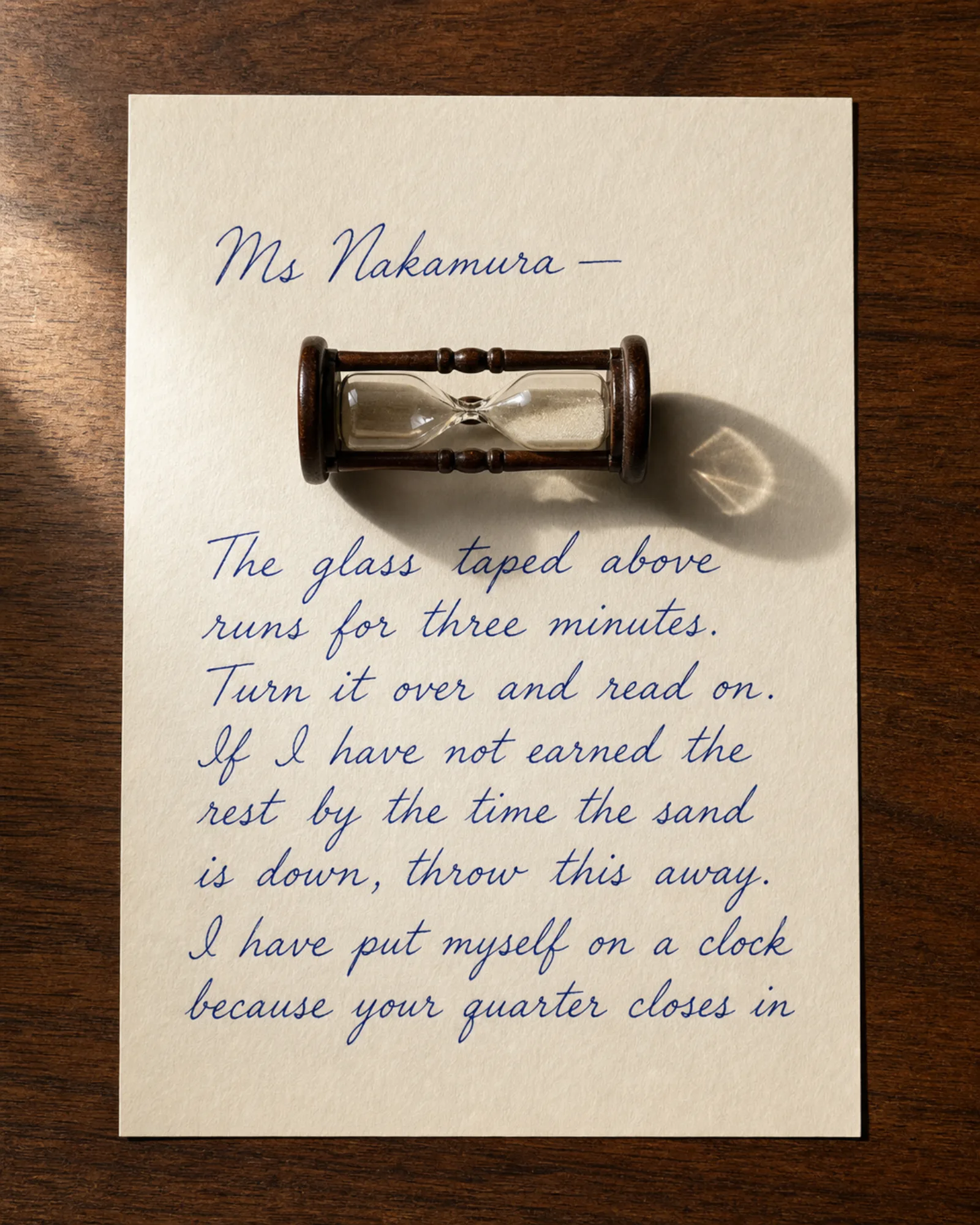
A small hourglass. An enclosure example.
A small hourglass
Useful when time is part of the buyer's problem. The letter can point to a slow process, a decision that keeps slipping or a task that takes attention away from other work.
The letter explains the delay your product helps solve and gives the buyer a concrete reason to act.
Before we ask someone to buy, we need to understand why they should.
We start with your website, sales material and the conversations you already have with customers. What are they buying? What makes them hesitate? What can you deliver better than the alternative?
We use the material you already have and work through the missing details with you. That gives us the product, the proof and the limits the campaign must respect.
Then we look for businesses with a reason to care.
The companies we leave out are part of the work.
A company can look perfect in a database and still be wrong for your offer. It may already be your customer. The relevant team may work elsewhere. Or the business may need something you do not provide. We check the reasons to exclude a company, not just the reasons to add one.
A full spreadsheet is not the goal. A defensible audience is.
A first name is not personalization. A reason to care is.
We do not start with a database and add a first name. We start with the commercial reason a specific kind of company might want what you sell, then find the person responsible for that problem.
Find the company that has a reason to buy.
Market Scan starts with the business file. We read what the product does, where it creates value and what makes a buyer capable of using it. Then we work out which kinds of companies might have a reason to pay. For every company, we need a reason this offer belongs on their desk.
The list begins with a reason to buy.
If you sell something complicated, your market rarely fits inside the category you put on the homepage. A tool sold to a software team might also help a service business running the same workflow. A product bought by a founder in a small company might be evaluated by an operations manager in a larger one. The job is to discover those differences before we write.
We carry the constraints into the search. Geography, delivery capacity, implementation effort, deal size, prerequisites and the situations you cannot handle all matter. A beautiful market map is useless if every company on it needs a product you have not built. We want an audience your business can serve when somebody answers.
We look beyond the first obvious markets.
Give a group of people a product and they will usually name the markets they already know. That is a reasonable starting point. It is also an easy place to stop. The familiar ideas feel convincing, so nobody spends the afternoon looking for the less obvious company with the same underlying problem.
I kept coming back to this in the Market Scan work. The hard part was making the system continue after the easy answers. It had to follow adjacent uses, study competing products and look at the companies buying those products. Then it had to explain the connection. Another industry name, on its own, adds almost nothing.
We expand the candidate markets and test the reasoning behind each one. Who has the problem? What creates it? What do they do today? Where does your product fit into that process? What evidence would make us take the idea seriously? Those questions turn a loose brainstorm into something we can inspect and improve.
Some ideas survive with strong evidence. Some remain plausible and need a small, deliberate test. Some fall apart when we read the source. We keep those outcomes separate. Uncertainty belongs in the working file, where it can influence a decision.
Competitors give us leads worth investigating.
We study competitors because they leave clues about the market. Their product pages, customer stories, integration pages and public descriptions show which problems they choose to explain. A customer logo can suggest a company to investigate. A detailed case study can reveal a workflow that the logo never could.
We follow the relationship carefully. Did that company buy the competing product? Was it a partner, an investor, a trial user or simply mentioned in an article? What was the actual use? A logo cloud cannot answer all of that. We go back to the surrounding material before turning a brand into a sales hypothesis.
The same care applies to an unusual customer. It might reveal a market nobody on the first call mentioned. It might also be a one-off project with conditions your business cannot reproduce. We look for another example and for the reason the use case exists. One attractive anomaly is a research lead.
This is where the business file earns its keep. We can compare a competitor's promise with your actual capability. If the promise depends on something you do not provide, we do not smuggle it into your letter. We either find a different angle or put the market aside.
We make each market specific enough to search.
Broad labels hide different businesses. A manufacturer, a distributor and a software vendor can all describe themselves with the same industry word. They buy differently. They have different margins, workflows and people responsible for the problem. A list built from the label alone mixes them together.
We describe the type of company we mean in practical language. What does it sell? Who does it sell to? How is the relevant work performed? Which condition makes the offer useful? We also describe the businesses that look similar but should be excluded. That second description saves a surprising amount of wasted research.
Related ideas are grouped when the buying logic is genuinely shared. We split them when the reason to buy changes. This keeps the research readable without flattening useful differences. You should be able to look at a market and understand why its companies belong together.
The result guides the search for actual organisations. It also gives the writer a coherent audience. A letter to a company operating a delivery fleet has to address the work of operating that fleet. Dropping the word logistics into a generic paragraph does not get us there.
The right job title changes from one market to the next.
We then ask who owns the problem inside each type of company. Who experiences it? Who can evaluate a solution? Who controls the budget or can bring the decision to the person who does? In a small business, those may be the same person. In a larger organisation, they may be several people.
This was one of the recurring problems in my Market Scan notes: people with relevant responsibility are called all sorts of things. Searching for founder and chief executive everywhere feels efficient until the search misses the person actually running the work. A senior title does not prove that the letter belongs on that desk.
We build the vocabulary for each market. We look at how companies describe their teams, responsibilities and current vacancies. We compare the titles used by similar businesses. We use those findings to search for the person, then check whether the responsibility still matches.
A name and a title are separate facts. So are the name and the employer. People move. Companies reorganise. We want the source behind the match and the date it was checked. If the evidence conflicts, the record needs another pass before the envelope gets a name.
We turn the research into companies and people.
Once the audience is clear, we look for companies that actually fit it. Each candidate should carry the reason it was selected. The company website, relevant public evidence and our notes stay attached to the record. Otherwise a carefully researched audience turns into a spreadsheet nobody can explain a week later.
For the person, we collect the first and last name, the relevant role and the relationship to the company. A middle name is included only when it is known and useful for identification. We do not invent one to make a row look finished. The name we print must be the name we can support.
We also seek a reachable business telephone number and the physical mailing address. Where an email address is available and relevant, it can sit in the record too. The physical letter needs a real receiving location, so an email match cannot substitute for an address check.
A main office switchboard and a person's direct business line are different contact routes. We label what we have. The same goes for a headquarters address, a local office and an address that appears to exist only for correspondence. The delivery team needs that distinction more than it needs a full-looking table.
An address has to survive contact with a courier.
Finding an address online is one step. Establishing that it is a sensible place to deliver this letter is another. We check the office, street address, suite or floor where available, and the connection between the location and the company. We look for signs that the company moved or that the intended team works elsewhere.
We also consider how the building receives visitors and correspondence. Some offices have a reception desk. Some have a central mailroom. Some need a delivery arranged in advance. Those differences affect the route and what can honestly be recorded as a handoff.
For this service, the research ends in a delivery-ready record: company, commercial reason, person, role, contact route, address and delivery notes. Where something material is missing, we resolve it or replace the candidate. The unresolved field is a task, not an invitation to guess.
We review the final audience with you before production. You may know that a company is already a customer, that a conversation ended badly or that a territory is unavailable. That knowledge belongs in the business file and in the exclusion list. It should reach the courier before the courier reaches the door.
Why I kept rebuilding Market Scan.
The source notes tell a fairly physical story. I was connecting research tools, looking at the gaps between them and writing the instructions that would make the next pass useful. A service could enrich a list. Another could search for a contact. I still needed something that could explain which list to build and why.
In the early work, I described a flow that joined business research, competitor research and the client's call recording in a single workspace. That was the point: the call should change the understanding of the business, and that understanding should change the campaign. I wanted the call, the research and the campaign to stay connected.
Later, I wrote about rebuilding the research through several versions. The challenge kept moving. Finding more ideas created a need to organise them. Organising them created a need to distinguish evidence from a convincing paragraph. Finding the companies exposed the vocabulary problem around roles and titles.
I kept connecting tools. The questions stayed the same. Why this market? Why this company? Why this person? What are we going to say? If the answer collapses when somebody asks for the source, the system has produced more work for us.
The instructions became part of the product.
A short request to research a business leaves a lot for a model to improvise. What counts as evidence? How far should the search go? What should happen when two sources disagree? When is a market too weak to pursue? If those questions are unspecified, the answer changes with the model's assumptions.
I spent time writing down the world each research step operates in, the task it has to complete and what it has to hand to the next step. The July notes describe an orchestrator coordinating 15 sequential sessions, followed by three reviewing judges. Each session had a job, and the reviews sent weak work back for another pass.
The useful principle is the handoff. A researcher should leave enough context for the next researcher to continue intelligently. A reviewer should be able to send back a weak section with a specific reason. A writer should receive a business file and an audience brief that answer the questions a letter depends on.
I kept finding the same problem: a paragraph sounded finished, then fell apart when I checked the claim. That sends the work back to research. A better sentence cannot supply a missing fact.
Research and writing get different jobs.
The researcher is trying to establish what is true and what is worth testing. The writer is trying to make a particular person understand an offer and take a sensible next step. These jobs share material, but they make different demands on it. We keep the evidence visible through both.
One of my writing experiments made this painfully clear. I gave a model the writing instructions without the client knowledge those instructions depended on. It could produce something that looked like a letter. That did not solve the missing-context problem. It had no solid account of the sender, the buyer or the reason for the approach.
That lesson is built into this campaign. The writer receives the approved facts about your business, the market logic and the facts about the recipient that actually matter. We use specific evidence where it earns attention. We remove invented familiarity, decorative compliments and claims the file cannot support.
Review is another job again. We check whether the argument fits the recipient, whether the proof supports it and whether the request is easy to answer. When the underlying fact is weak, polishing the sentence is the wrong repair. The research goes back for another pass.
We keep the trail from source to envelope.
A campaign contains several versions of the truth as the work improves: the original material, our first interpretation, a corrected audience and an approved letter. We retain enough of that trail to understand what changed. The version on the printer must match the version you approved.
The recipient record connects the company and person to the final letter and the selected physical object. It also carries the address and delivery instructions. That connection matters when the report arrives. You should not have to work out which copy was sent to which office from a pile of filenames.
We use missing information as a stop signal at the point where it matters. An unverified name needs checking before personalisation. An uncertain office needs checking before routing. A claim without support needs checking before approval. Fixing an empty field is much cheaper while the letter is still on a screen.
You can follow a selected company from the research through to its letter and delivery record.
Replies change the next decision.
After delivery, the campaign has new information. A recipient can be interested, decline, name another person, explain that the timing is wrong or simply say nothing. These outcomes mean different things. A replacement contact can improve the next approach. A clear objection can expose a weakness in the offer.
We add the response and delivery evidence back to the campaign record. We distinguish what the courier observed from what the recipient actually said. A receptionist accepting an envelope does not establish that an executive read it. A quiet week does not tell us why there was no reply.
When a response challenges a market assumption, we review the assumption. We can change the audience, the angle or the next question. The point of keeping the research is that we have something specific to revise. A campaign should leave the business better informed about its market, including when an idea fails.
Market Scan is the research engine inside this service. The physical campaign adds writing, production, delivery and reporting around it. The longer development story lives on its own page, with the original sequence of problems and revisions. You can read that before you send us anything.
One market can hide behind a hundred different names.
One of the practical problems in the development notes was vocabulary. A company can belong to the market you want and describe itself in words you never searched. In the gambling example, the notes list igaming, real money gaming, gambling and casino. A search for one label gives you one view of the market. It does not settle who belongs in it.
That is why the research expands the names before it expands the list. We collect the language companies use about themselves, the language their customers use and the names used in specialist directories. Then we check which words actually describe the buyer we want. Similar words can lead to very different businesses.
Take a supplier selling an operational service. A software vendor serving an industry may have an entirely different reason to buy from a company operating inside that industry. Putting both into a broad category hides that difference. We separate the commercial situations, then decide which ones deserve a letter.
You should be able to read a market description and recognise a business that could buy. If the description covers almost everyone with a website, the work needs another pass. The objective is a search we can execute and an argument we can defend when a company reaches the shortlist.
The brief can disagree with the website.
In one development note, the input supplied by the client comes first, the landing page second and the material found through search third. That is a useful way to understand the problem. Websites can lag behind the business. A founder can be selling something different from the offer still sitting on the home page.
We keep those disagreements visible. If the brief describes a new product and the website describes the old one, we ask which facts the campaign may use and what evidence supports the new offer. We do not blend the two into a fluent paragraph and hope nobody notices.
A sales call can contain the detail that changes the audience. A lost proposal can reveal a condition that makes the service a bad fit. An analyst can point out that a competitor's customer looks attractive but needs something you cannot deliver. These belong in the business file because they change who should receive the letter.
This also gives you something specific to correct. You can tell us that a market is interesting but the timing is wrong, or that a product claim needs narrower wording. The next research pass then starts from the correction. It does not rediscover the same mistake under a different heading.
We need the reason to exclude a company, too.
A useful scan reduces work as well as finding it. We may remove a company because the relevant function is outsourced, the product needs infrastructure it does not have, or the decision sits outside the delivery area. Those are different reasons. Keeping them separate makes the next search better.
We also separate an unsuitable company from an unreachable person. The business may be an excellent fit, yet the intended recipient has moved or the building accepts deliveries only through a central room. That is a delivery problem to resolve before printing. It does not automatically invalidate the market.
For a physical campaign, this is where research meets the route sheet. We need a workable entrance, the correct office, an acceptable receiving person and enough geographic concentration to use courier hours well. Grouping the offices into workable routes keeps the research useful to the delivery team.
We group the addresses into city routes and brief the couriers before dispatch. They need to know which office to enter, who the letter is for and how the building receives deliveries. The research goes all the way to the door.
I kept rebuilding Market Scan because a list of names still left the hard questions unanswered: why this company, which person and what do we say? The full story follows the searches, failed approaches and rewrites.
We have the offer, the company and a reason to approach this person. The opening explains why we are writing. The body gives them enough evidence to consider the offer. The last line asks for a next step they can actually take.
I check a selling text against the file. Can we support the claim? Is the offer clear to this recipient? Can they answer without doing another hour of work? If a paragraph helps with none of that, it is taking up space.
We write and review the versions before anything is printed. You see the audience, the text and the object together. That lets you judge the whole approach. We also check the less glamorous details: the right name, the right company, a working reply route and the exact claim your team is willing to stand behind.
The five letters below are original examples for our own service. They show different arguments built from the same offer. Your campaign uses your business facts, your recipients and the offer you want them to consider.
Start with 1,000 desks, not 10,000 names.
Hello,
You probably do not need more leads.
You need a small number of companies with a real reason to buy — and the right person inside each one.
That is where we start.
At coin.im, we study the offer, research the market, choose the companies, find the relevant person and write a physical sales letter explaining why we approached them.
Then we print it, attach a physical grabber and arrange delivery.
The pilot is 1,000 letters for $3,800.
If the audience and angle deserve more scale, 10,000 letters are $30,000.
Send me your website. That is enough for us to start with the business behind the letter.
Anton,
coin.im
The coin has one job.
Hello,
The coin attached to this letter is worth almost nothing.
That is not why it is here.
Its job is to interrupt the ordinary pattern of business correspondence long enough for me to explain why I wrote to you.
That is how we think about physical grabbers at coin.im.
The object earns attention.
The opening explains the object.
The sales argument earns the next minute.
And the research gives us a reason to put the letter on that particular desk in the first place.
A 1,000-letter pilot is $3,800.
A 10,000-letter campaign is $30,000.
If you want us to look at the business behind your letter, send me your website.
Anton,
coin.im
Fix the weak idea before it reaches the printer.
Hello,
Before one of your letters goes out, you can inspect the audience, the argument and the physical piece together.
You can ask:
Why this market?
Why this company?
Why this person?
Why this opening?
Why this object?
If an answer is weak, we would rather find out while the campaign is still on a screen than after 1,000 envelopes have been prepared.
That is one reason we offer a pilot.
1,000 researched, written, prepared and delivered letters are $3,800.
When you are ready for broader scale, 10,000 are $30,000.
Send us your website and we can start with the first question:
Who actually has a reason to care?
Anton,
coin.im
‘Delivered’ is not enough.
Hello,
Someone tells you:
‘The sales letter was delivered.’
Fine.
But to whom?
At which address?
Who actually accepted it?
Which version of the letter was inside?
What physical object went with it?
Did anyone reply?
We build the campaign record around those questions.
The recipient, piece, address, handoff and available response stay connected so you can see what actually happened instead of staring at a mailing total.
The pilot is 1,000 letters for $3,800.
The scale campaign is 10,000 for $30,000.
If that level of visibility matters to you, send us your website.
Anton,
coin.im
Seven jobs. One campaign.
Hello,
Here is what has to happen before a physical sales letter reaches the right desk:
Understand the offer.
Find the market.
Choose the company.
Find the person.
Write the argument.
Produce the piece.
Deliver it and record the outcome.
Leave one of those jobs disconnected from the others and the campaign gets weaker.
At coin.im, we run them as one campaign.
You can start with 1,000 letters for $3,800.
When you want broader scale, 10,000 letters are $30,000.
Send us your website.
We will start at the beginning: the offer and the people who might have a reason to buy it.
The five samples above were written for coin.im. Below are five actual historical pieces from the American copywriting archive we studied: three sales letters and two print advertisements. Each has a short original excerpt, our reading of the technique and a link to the complete piece.
We study how each opening earns attention, how the body supports the offer and how the closing asks for a response. Then we write from your business file.
Gary Halbert: the Famous Dollar Letter
Sales letter. Original excerpt:
“I have attached a nice, crisp dollar bill”
The reader can touch the opening sentence. The enclosure gives the first line a job: explain why money is attached to a letter. That physical interruption creates an opportunity for the argument that follows.
For our coin example, the same question applies. Why is this object here, and how does the explanation lead to the business offer? If the object and the argument have nothing to do with each other, we need a better idea.
“your family name was recorded with a coat-of-arms”
The product is tied to something the recipient already recognises as personal: a family name. The relevance is built into what is being sold. That gives the reader a reason to continue before the letter needs a long explanation.
For a business letter, the equivalent is a verifiable commercial reason to approach that company. A first-name greeting does not do this work. The offer has to connect to the recipient's situation.
The letter gives the food a specific occasion and describes an experience the buyer can imagine sharing. It goes on to build a detailed argument for the product rather than leaving the headline to carry the whole sale.
For our campaigns, this means finding the concrete buying situation. Who needs the offer, what are they trying to accomplish, and what detail helps them evaluate it? Enthusiasm earns its place when the supporting facts are there.
The opening puts the reader inside a scene before introducing the course. The rest of the headline promises a reversal. The reader has a reason to ask what happened next, and the product enters through that story.
A business letter can also begin with a recognisable situation: the task taking too long, the customer being lost or the opportunity sitting untouched. The business file gives us the detail to write it.
Gary Bencivenga: the agency guarantee advertisement
Print advertisement. Original excerpt:
“guarantee to outpull your best ad”
This opening names an outcome an advertising buyer can evaluate against work they already have. The promise is concrete enough to invite scrutiny. Reading the complete advertisement shows how much explanation a forceful promise can require.
For coin.im, the offer is concrete: start with 1,000 letters for $3,800, or run 10,000 for $30,000. Research, writing, preparation, delivery and reporting belong to the same campaign.
That is why you review the audience, the letter and the selected grabber before production. Check the claims. Challenge the targeting. See the piece that will represent your business.
Audience → Letter → Physical piece → Your approval → Production
The time to challenge a weak claim is before it carries your name.
Then we print the letters, attach the grabbers, match each piece to its recipient and prepare the envelopes or packaging.
We check the names, addresses, readability and attachment. The piece should be easy to open, handle and read.
The mailing is ready. Next comes the route to the office.
The courier is part of the ad.
The campaign does not end when the printer stops. The way the letter reaches the office is part of the experience, which is why the recipient, address and handoff are planned before dispatch.
A courier takes your letter to the office.
We assign a courier to the city route. That person is briefed on the recipient, the office and the handoff. Their clothing is deliberately chosen and well presented, with a distinctive look suited to your campaign. They are the person arriving on your behalf. The presentation matters.
The courier carries the prepared letter to the approved address and seeks a hand-to-hand delivery. The delivery record names the recipient or the colleague who accepted the envelope at reception.
The courier records delivery evidence, including video where the handoff can be filmed. If you want an immediate reply, a planned visit can include a 10 to 15 minute wait. The recipient may answer, ask for time or decline. The courier records what happened without pushing a conversation that the person does not want.
When an office is unavailable, we organise the next delivery attempt with the route team.
10 US cities. Pick the ones your buyers are in.
We deliver in the following 10 cities:
We concentrate the campaign where your buyers are. The audience determines which cities and offices belong on the route.
New York
San Francisco
Los Angeles
Austin
Miami
San Diego
Denver
Boston
Seattle
Atlanta
We agree the city selection and practical delivery area before production. A company with a famous headquarters elsewhere can still be relevant if the person we need works at an office inside the campaign area. The address belongs to the plan.
A handoff. A read. A reply. Three different things.
An envelope accepted at reception is not proof that the intended person read it. A read is not a reply. A reply is not a sale. We keep those events separate, so the report tells you what the evidence supports.
See who accepted your letter.
Your report connects the approved letter to its intended recipient, the delivery address and the person who accepted it. Courier notes, available delivery video and any recorded response stay with that record.
What each delivery record contains
The piece
Approved letter version and the physical object enclosed.
The people
Intended recipient, company and the person who actually accepted it.
The place and time
Delivery address, visit time and the outcome of the handoff.
The evidence
Available delivery video, courier notes and any recorded reply.
The reading status
Reading is recorded only when supported by direct evidence. Delivery alone does not establish that the letter was read.
Start with what a new customer contributes after the variable cost of serving them. Add any other acquisition costs you want to include. Then see how many additional customers would cover those costs.
Revenue minus the variable cost of serving that customer, over the period you choose. Do not subtract this campaign’s acquisition costs here.
Enter an amount greater than $0.
Optional. Include costs beyond the campaign price, such as additional sales work.
Enter $0 or a positive amount.
Additional customers needed to cover the costs entered
Enter your contribution per customer to see the calculation.
This is a cost-coverage calculation, not a forecast. It does not predict replies, sales or whether those customers will come from the campaign.
Start with 1,000. Scale to 10,000.
Same campaign system. Two volumes.
Business research, Market Scan, recipient selection, sales copy, physical grabbers, printing, packaging, delivery and reporting are included.
Pilot at $3.80 a letter. Scale at $3.00.
Start small enough to inspect the approach. Scale when you want more of it.
PILOT
1,000 letters
$3,800
$3.80 per letter
Test an audience, angle or concentrated market before committing to a larger run.
No. Company and recipient research and sales copy are part of the campaign. Existing customer lists and exclusions are useful inputs, not prerequisites for writing to us.
Does 1,000 letters mean 1,000 replies?
No. The quantity refers to physical campaign letters, not replies, meetings or customers. Responses depend on the recipients and the offer.
Can I review the campaign before printing?
Yes. You review the audience, the letter and the selected physical grabber before production.
Can the campaign reach any US address?
No. Delivery is planned within the 10 US cities listed on this page. The city selection and practical delivery area are agreed before production.
coin.im
Start with your website.
What do you sell? Who buys it today? Which customers would you like to reach next?
Send your website and a way to reach you. We can discuss who the campaign should reach, what it should say and whether a pilot makes sense for your business.
You do not need to write the brief. Start with your website.
Your website, name and work email are enough to start. Everything else is optional.
Your website is with us.
Thank you. We have received your details and will use your contact information to continue the conversation.